

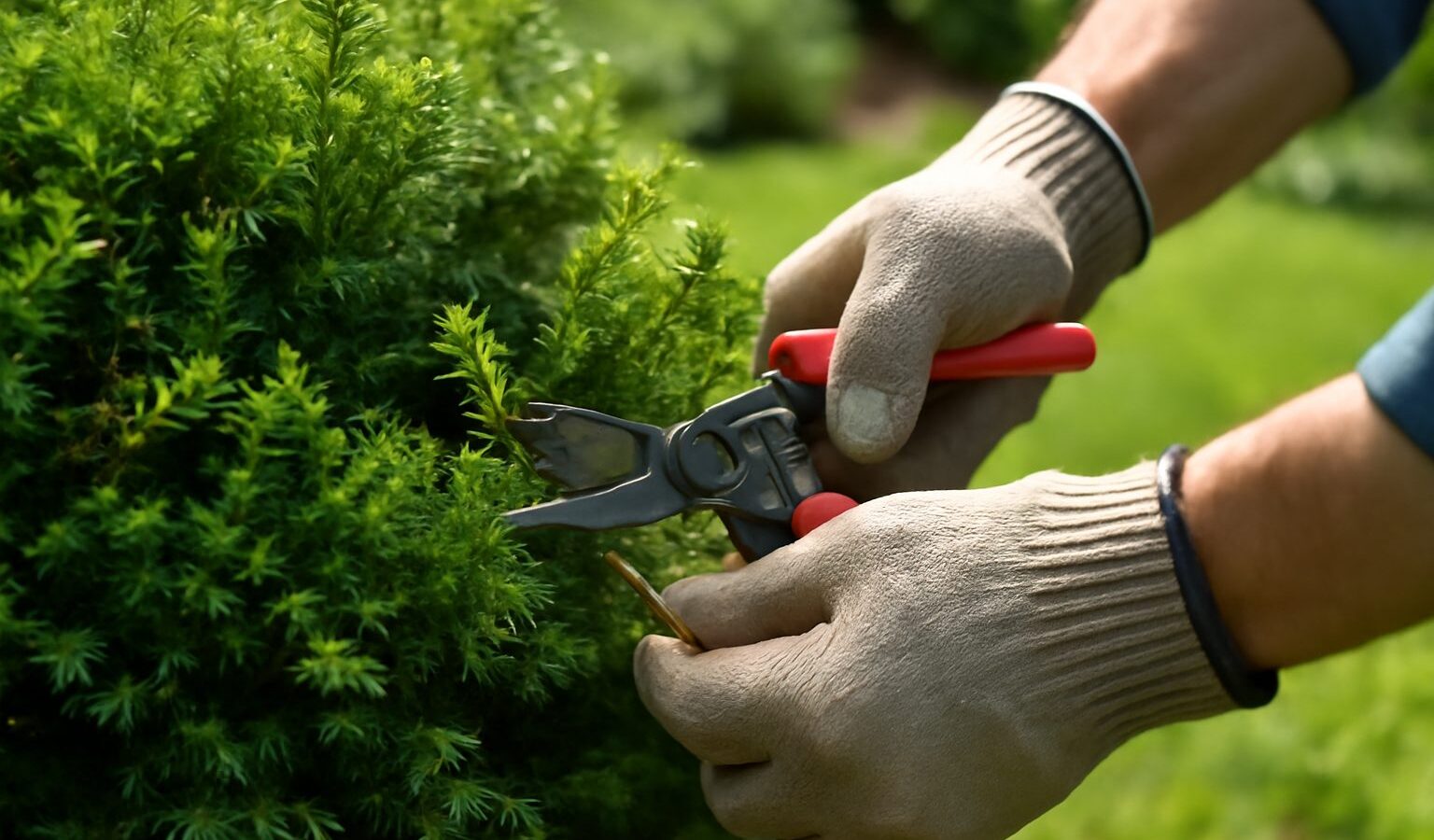
Evergreens are pruned by a different rulebook than the deciduous shrubs most gardeners cut their teeth on. The biggest difference is brutal and unforgiving: many needled evergreens — pines, spruces, junipers, arborvitae — will not regrow from bare wood. Cut a yew or arborvitae back past its green growth into the brown interior and you are left with a permanent dead hole that never fills in. Broadleaf evergreens like boxwood, holly, and rhododendron are more forgiving, and conifers fall into two camps depending on whether they grow from a single point each spring or branch freely. Knowing which kind you are standing in front of is most of the job. This guide covers when to prune, the right technique for each group, and the mistakes that scar an evergreen for life.
Key Takeaways
- Most conifers won’t regrow from bare wood. Never cut past the green into the brown interior of pines, spruces, junipers, arborvitae, or yews.
- Late winter to early spring is the safe default. Prune most evergreens just before the spring growth flush; avoid late-summer and fall cuts.
- Know your conifer group. Whorled conifers (pine, spruce, fir) are pruned at the candle/new-growth stage; random-branching ones (juniper, arborvitae, yew) tolerate light shaping.
- Light and regular beats hard and rare. Small annual trims keep evergreens dense; drastic cuts leave bare gaps that may never close.
- Always cut to a growing point. Cut back to a side branch, bud, or lateral that still has green growth — not into bare stems.
First, Identify What You’re Pruning
Evergreens divide into three practical groups, and the right approach depends entirely on which you have.
- Whorled (random-budding) conifers: pines, spruces, and firs. These produce new growth from “candles” — the soft new shoots that extend in spring — and branch in regular whorls. They have very limited ability to push new growth from old wood.
- Random-branching conifers: junipers, arborvitae, yews, hemlocks, and false cypress. These branch more freely and tolerate light shaping, but most still will not regenerate from completely bare, brown interior wood (yews are the partial exception and can resprout from old wood).
- Broadleaf evergreens: boxwood, holly, laurel, rhododendron, azalea, camellia, euonymus. These behave more like deciduous shrubs, resprout readily from older wood, and are the most forgiving to prune.
When to Prune Evergreens
The safe, all-purpose window for most evergreens is late winter to early spring, just before the new growth flush, when the plant is poised to heal cuts and refill quickly. There are a few important nuances:
- Pines: prune by pinching or cutting the soft “candles” in late spring as they elongate but before the needles fully expand. Do not cut pines back into old needleless wood at any time.
- Spruce and fir: trim the new growth in spring; you can cut just above a visible bud on the new shoot to control size.
- Juniper, arborvitae, yew, hemlock: light shaping in early spring before growth starts, with optional minor touch-ups in early summer. Avoid late-season cuts that force tender growth before winter.
- Spring-flowering broadleaf evergreens (rhododendron, azalea, camellia): prune right after they finish blooming, so you do not remove next year’s flower buds.
- Boxwood, holly, laurel: shape in late spring after the first flush; a light second trim in mid-summer is fine. Avoid pruning in a heat wave or hard freeze.
As a rule, stop any significant pruning by late summer. Cuts made in late summer or fall can stimulate tender new growth that winter then kills, weakening the plant.
The Dead-Zone Rule (Read This Before You Cut)
If you take one thing from this guide, take this. Most needled evergreens have a dense outer shell of green growth and a shaded, leafless “dead zone” of brown wood underneath. On pines, spruces, junipers, and arborvitae, that brown interior wood has no latent buds and will not produce new growth. If you shear or cut back past the green and expose brown wood, you create a permanent bare hole or a brown stub that stays brown forever.
The practical consequence: you can keep an evergreen at its current size or trim it slightly smaller, but you cannot dramatically reduce an overgrown conifer by cutting it back hard the way you might rejuvenate a deciduous shrub. Every cut must leave green foliage on the branch beyond it. If a juniper or arborvitae has outgrown its space, the honest answer is often to replace it rather than butcher it into permanent brown patches. Yew is the main forgiving exception — it can resprout from older wood and tolerates harder renovation.
Pruning Technique
Cut to a growing point
For selective, natural-looking pruning, reach into the plant and cut each branch back to a side shoot, bud, or lateral branch that still carries green growth. This hides the cut and lets the plant continue from that point. Avoid leaving stubs, which die back and look ugly. Use clean, sharp bypass pruners for small stems, loppers for thicker branches, and a pruning saw for anything over an inch.
Shearing vs. hand-pruning
Shearing (the flat, all-over haircut with hedge shears) is appropriate for formal hedges and tight broadleaf evergreens like boxwood, but it creates a dense outer shell that shades out the interior. Over years this thins the inside and can leave the plant hollow. For most evergreens, selective hand-pruning that reaches into the plant produces a healthier, more natural form and keeps light reaching the interior foliage. If you do shear a hedge, shape it slightly wider at the bottom than the top so sunlight reaches the lower branches and the base stays green.
Pruning evergreen trees and removing limbs
For larger evergreen trees, focus on removing dead, diseased, damaged, or crossing branches, and on maintaining a single central leader. When removing a whole limb, cut just outside the branch collar (the slightly swollen ring where the branch meets the trunk) — never flush with the trunk and never leaving a long stub. For branches over an inch or two, use the three-cut method to avoid tearing the bark. This is exactly the same collar-cut principle used when taking limbs off any tree; for broader tree work, see our Outdoor Living guides.
Common Evergreen Pruning Mistakes
- Cutting into the dead zone. The number-one error — shearing a conifer back into brown wood leaves a permanent bare hole. Always leave green beyond your cut.
- Trying to drastically shrink an overgrown conifer. It does not work on most needled evergreens; size them with light annual cuts or replace them.
- Pruning at the wrong time. Late-summer and fall cuts force tender growth that winter kills; pruning spring bloomers before they flower removes the show.
- Topping trees. Cutting the top off an evergreen tree ruins its form, creates weak regrowth, and invites decay — never top a conifer.
- Shearing hedges narrower at the base. This shades the bottom, which thins and browns out. Keep the base wider than the top.
- Leaving stubs or flush cuts. Stubs die back; flush cuts wound the trunk. Cut to a growing point or just outside the branch collar.
The overarching lesson with evergreens is that little and often wins. Light annual maintenance keeps a plant dense, healthy, and the size you want, while neglected evergreens cannot be rescued with one heroic hard pruning the way many deciduous shrubs can. For more seasonal yard-care projects, browse the full Outdoor Living collection.
Frequently Asked Questions
Can I cut an evergreen back hard to reduce its size?
Usually not. Most needled evergreens — pines, spruces, junipers, arborvitae — will not regrow from bare brown wood, so cutting past the green leaves a permanent dead hole. You can trim them slightly smaller with light annual cuts but cannot drastically shrink them. Yew and many broadleaf evergreens are exceptions that tolerate harder pruning.
When is the best time to prune evergreens?
Late winter to early spring, just before the spring growth flush, is the safe default for most. Pines are pinched at the candle stage in late spring, and spring-flowering broadleaf evergreens like rhododendron and azalea are pruned right after they bloom. Avoid significant pruning in late summer and fall.
How do I prune a pine differently from a juniper?
Pines grow from candles — soft new spring shoots — so you pinch or cut those candles in late spring to control size, never cutting into old needleless wood. Junipers branch more freely and are shaped with light selective cuts in early spring, always leaving green foliage beyond each cut.
Why does my sheared evergreen hedge look hollow inside?
Repeated shearing builds a dense outer shell that shades out and kills the interior foliage, and shaping the hedge narrower at the base starves the bottom of light. Keep the base wider than the top, and mix in some selective hand-pruning to let light reach inside and keep the interior green.
Is it ever okay to top an evergreen tree?
No. Topping — cutting the top off the tree — destroys its natural form, produces weak, crowded regrowth, and creates large wounds that invite decay. To remove a whole limb, cut just outside the branch collar instead, and never remove the central leader of a conifer.